Design: cyprus institute
I design things to support my work and others: exhibitions, architecture, furniture, hardware, and graphics. Making is a form of study—combining traditional techniques with new technologies to find low-cost, DIY methods that yield surprising qualities. I like artifacts that straddle boundaries: virtual/physical, analogue/digital, traditional/progressive.
About
I design things to support my work and others: exhibitions, architecture, furniture, hardware, and graphics. Making is a form of study—combining traditional techniques with new technologies to find low-cost, DIY methods that yield surprising qualities. I like artifacts that straddle boundaries: virtual/physical, analogue/digital, traditional/progressive.
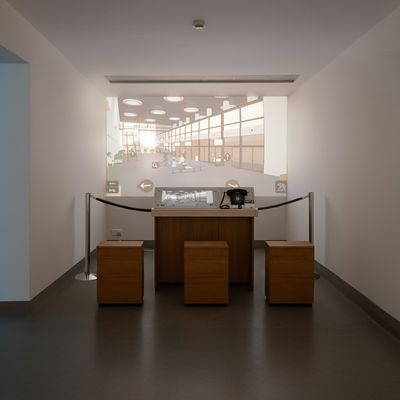
Nicosia International Airport VE
A museum installation featuring a reconstructed 3D model of Nicosia International Airport's modern terminal based on LiDAR scans and archival documentation, housed in a custom-designed wooden console with touchscreen navigation and immersive projection. I developed the participatory virtual environment to test dissertation methodologies on co-constructive virtual places for heritage, featuring a "propositional model" for directing public knowledge toward architectural features, and a period landline phone interface for oral story contribution. I also designed and developed the companion website at velab.cloud/nic/en. Deployed in a public exhibition at the Bank of Cyprus Cultural Foundation, the project captured over 3,200 play sessions and 300 oral story recordings, generating new qualitative data that expands and challenges the site's limited documentation. See the development timeline for in-progress screenshots and photos.
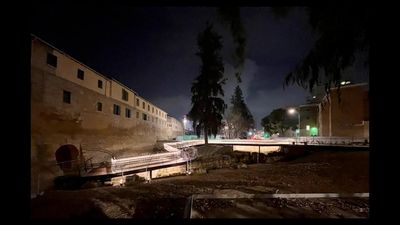
Paphos Gate: Nicosia
Multiple VR applications (using Oculus DK2 and HTC Vive) to visualize archaeological findings and a proposed architectural intervention for an urban archaeology project in Nicosia. I prototyped and built the applications as a research assistant, developing systems for locomotion, interaction, and gaze-tracking analytics to understand how stakeholders focused on the virtual site. These tools engaged everyone from the public to the Department of Antiquities. The gaze-tracking data directly informed the design of the final public walkway and was integrated into the permanent VR exhibit at the museum. The project spanned a decade before the site and its permanent VR exhibit opened to the public in 2024.
Quantum Itineraries Live Visuals
A suite of tools and visualizations in Unity for live-generated 3D visuals projected behind performers at 8K for dome or classical displays, using procedurally generated meshes and shaders. I built the system for the Quantum Itineraries music performances, a festival featuring quantum computer music where quantum simulations are core to composition and instrumentation. The quantum simulation data that generated the music also drove the visuals directly, with WebRTC routing Unity's output to a mixer for the projection.
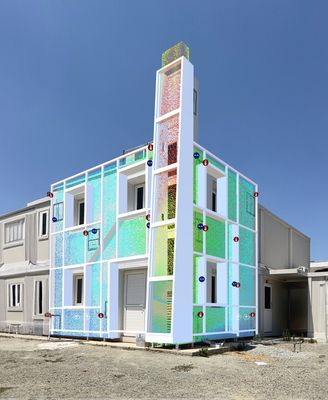
MESH AIRFLOW Visualization
An AR visualization of airflow patterns for a secondary facade system designed by the Cyprus Institute. I took the researchers' 2D computational fluid dynamics (CFD) simulations (heat and flow maps) and UV mapped them onto a 1:1 scale 3D model of the facade, then built a shader to animate these maps with particles, inspired by how Portal 2 visualizes fluid dynamics. In the final application, users scan a QR code on the test building and see the internal 'stack effect' in action, with callouts indicating sensor locations.
BEEP Energy Sim
An AR energy-use visualization that lets stakeholders view expected energy loads for every room in a heritage building over the year using a phone or tablet. A slider scrubs through a full year of data, built to explain green infrastructure investments for the adaptive reuse project. More information on the project can be found here.Technical: I baked 3D room volumes into an optimized mesh whose vertex UVs encode positions on a packed lookup texture for GPU-driven animation without CPU overhead. The project also showcased Wikar's 3D section slicer, which recomposes standard shaders into slicable equivalents using 3D SDF intersections with a stencil pass for back-face fill.